SOS Suburbs logo-1
SOS Waverley
Protecting the character, amenity and liveability of our community

SOS Waverley has been formed to represent residents who are concerned about the scale and speed of development being pushed into our area. We stand for proper planning, community consultation, and the protection of our local environment and neighbourhood character.
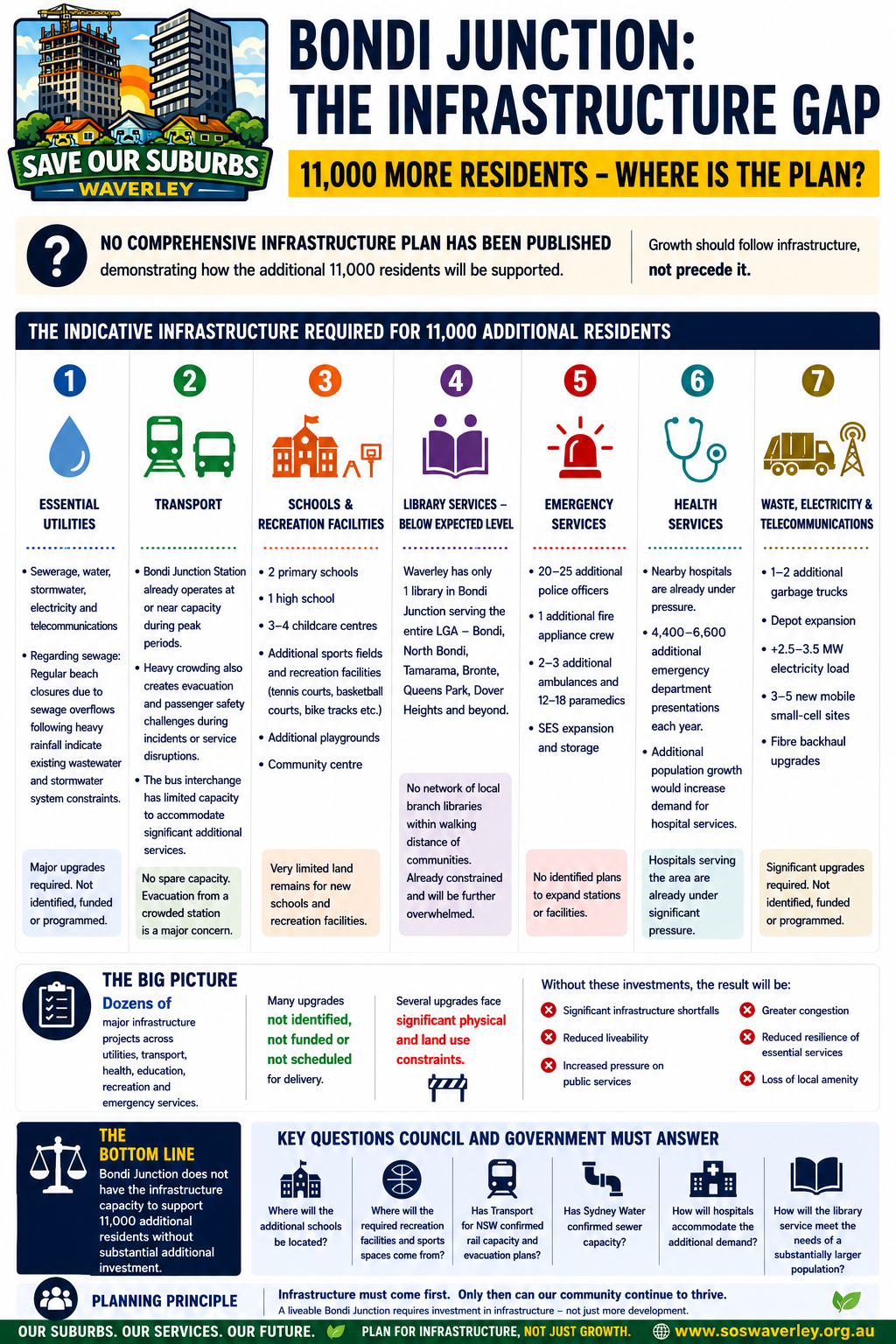

 

Bondi Junction infographic update for web

SOS Waverley Submission on the Bondi Junction Vision and Masterplan

Dear Ms Scott,

Thank you for the opportunity to provide written feedback on the Bondi Junction Master Plan (‘Master Plan’).

SOS Waverley has been formed to represent residents who are concerned about the scale and speed of development being pushed into our area. We stand for proper planning, community consultation, and the protection of our local environment and neighbourhood character.

We strongly oppose the Master Plan, and express our key issues with it below:

Lack of transparency and poor governance

Notices of motion at the June 2026 Council meeting demonstrate a total lack of transparency regarding the potential impacts of the Master Plan on Bondi Junction. In order to make an informed submission, the community needs access to the crucial information, such as shadow diagrams and 3D models, to understand the potential impacts of the Master Plan in the real world.

Most people will have difficulty understanding the true potential impacts of development based on maps on a page and vague statements of principle. An extended exhibition where all the information is available is plainly necessary for the community to make an informed submission given the substantial changes proposed as part of the Master Plan.

Low- and mid-rise housing reform

The Master Plan delivers significant dwelling uplift. The State government’s previous LMR reform already enabled significant uplift around the Bondi Junction town centre, well beyond what is contemplated under the current LEP, and in the process effectively overriding any meaningful heritage protections.

It is unclear how much uplift is being delivered as part of that Plan, and how this uplift relates to the significant uplift afforded under the LMR.

The Master Plan must contain a commitment to disable the LMR provisions surrounding the Bondi Junction Town Centre. Further dwelling numbers merely exacerbate existing issues as discussed in this submission. It is unclear why Council would seek to facilitate uplift under both the LMR and the Master Plan given the substantial dwelling numbers under both.

One of the community sessions in development of the Master Plan asked us how to address a trade-off of consolidated density versus dispersed change. It’s not clear which option has been adopted. The concurrent application of the LMR and the Master Plan would suggest that neither option has been chosen; rather, the choice is to maximise the potential uplift.

Removal of floor space ratio provisions

Floor space ratio is a key tool in controlling the density of development within a locality. It sets a standard for the level of noise, traffic, and building bulk which could be delivered in a given precinct, and consequential the amenity impacts on surrounding landowners.

Removal of FSR in some zones will inevitably lead to building envelopes being maximised, resulting in smaller setbacks, less building separation, and poor outcomes. FSRs must be calibrated to the desired built form, such as slim towers which allow shadows to pass faster and retain a better semblance of openness. Providing carte blanche for developers to fill sites with bulk is a poor outcome which ought to be avoided.

Public infrastructure funding

The Master Plan details nearly $200 million of new public infrastructure, including parks, a new library, streetscape upgrades, and so forth. What modelling has been conducted to demonstrate that, predominately, development contributions are capable of funding this? Section 7.11 contributions are presently limited to $20,000 per new dwelling, which assuming that all 3,000 dwellings can be levied at this rate (ignoring potential exclusions or discounts) equates to only $60 million.

The significant change to Bondi Junction which residents are being asked to accept is in large part being sold on the basis of these new works which purport to be a public benefit. However, there is no evidence in the Plan that these works can be delivered, and it’s likely that there will be a significant funding gap which will see uplift delivered without the infrastructure and commitments necessary to support the population increase.

Overshadowing protections

Any overshadowing protections, such as those proposed for Clementson Park, must be secured under the LEP. The increasing number of so-called state significant development applications allows the DCP to be ignored, rendering inoperative considerations of solar access enumerated therein. Strong solar access protections, similar to those in the City of Sydney, must be adopted to ensure that solar access is maintained, and is not degraded by the cumulative impact of new developments in a race to have their building approved first.

Certainty of implementation

The Master Plan is understandably a higher-level document, and it is acknowledged that many of the technical requirements, such as stormwater, traffic, utility servicing, and so forth, haven’t been considered in intimate detail. However, there is clear uncertainty as to whether the plan can be delivered, and a lack of understanding of the potential infrastructure commitments that will need to be delivered to fix existing issues and accommodate further population increases.

For example, there is no understanding of potential land acquisition requirements for road widening; is there any certainty that this will be considered under a planning proposal? How much will the capital works for road or stormwater upgrades cost ratepayers, and are the utility companies ready and willing to upgrade infrastructure to accommodate new uplift, in addition that the uplift under the LMR?

The Master Plan needs to be reviewed by appropriate subject-matter experts to determine whether its outcomes can be feasibly developed, without undue cost to ratepayers. Further, any necessary infrastructure upgrades must have both their funding and footprints secured as part of any planning proposal, else Bondi Junction will be left with 3000 extra dwellings and no infrastructure to accommodate new residents.

Secure commitments

If the Master Plan is ultimately adopted, the Contributions Plan must be updated forthwith. The increasing number of state significant developments and the uplift generated by the Housing Delivery Authority means that the monetary and other commitments necessary to deliver on the public infrastructure commitments may be lost. Unless there is a clear legal mechanism for these resources to be secured, it’s possible we will end up with uplift that has not paid for the necessary infrastructure.

Housing Delivery Authority

The HDA has been given a mission by the State Government to ‘deliver’ housing, including through concurrent rezonings. The Master Plan is (ostensibly) a coherent and desirable vision for the locality where the controls reflect an underlying logic. Implementation of the Master Plan must be contingent on the HDA no longer entertaining concurrent rezonings within Bondi Junction. Furthermore, if the Master Plan is adopted, Council staff must take an aggressive stance on submissions to the State government, opposing any matter contrary to the Master Plan and the broader public interest.

Conclusion

To reiterate, SOS Waverley strongly objects to the Master Plan in its current form. It is an inappropriate way of attempting to satisfy housing ‘targets’, and results in a poor outcome at the expense of the public.


Oxford St Mall shadow
Oxford Street Mall Upgrade

This is how the mall will look at lunchtime. Not much sunlight, not very inviting and people just passing through to the station and the shopping centre. 

Questionnaire
We’d Love to Hear From You

We’d Love You to Join SOS Waverley

SOS Waverley relies on local residents to strengthen our community voice.

Membership is $30 per year and helps cover essential costs such as printing, website hosting, incorporation fees and community campaign materials. 

Please complete our short membership form and let us know how you’d like to be involved: SOS Waverley Membership/Questionnaire
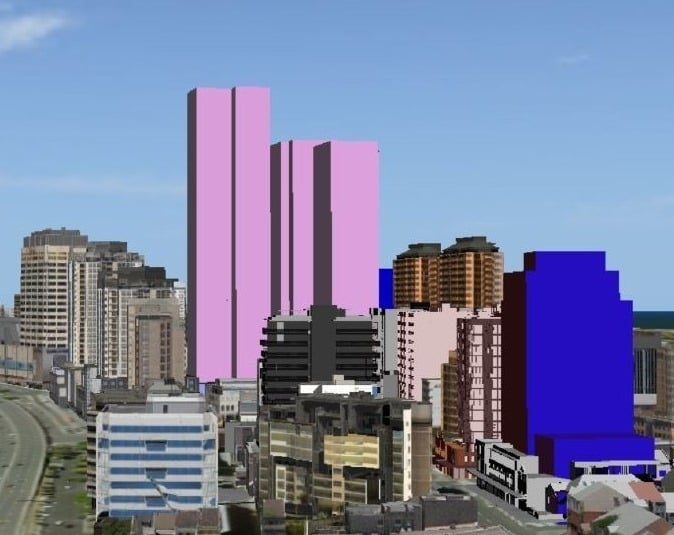
Development corner Mill Hill Rd and Oxford Street~4 crop
How to make submissions

Residents often ask how to track projects and lodge submissions. Here’s a simple guide.


Council Development Applications (DAs)

For developments that are not State Significant Developments, use Council’s DA Tracker.

What you can do

DA Tracker: https://www.waverley.nsw.gov.au/planning/development_applications/track_a_da

Submission Guide: https://www.waverley.nsw.gov.au/planning/development_applications/community_consultation/da_submission_guide

State Significant Developments (SSDs)

These projects are assessed by the NSW Government, not Council. Council may make a submission, but it does not have approval authority.

To object or comment, you must lodge a submission through the NSW Planning Portal during the 14‑day Exhibition Period. These periods open without notice, so regular monitoring is essential.

Planning Portal: https://www.planningportal.nsw.gov.au/major-projects

Tips

  • Create an account early — activation can take a few days
  • Search by LGA to see projects in Waverley
  • Check On Exhibition for open submissions

Current SSDs / Expressions of Interest in the Bondi Junction Precinct

  • SSD 77175998 – 194–214 Oxford St & 2 Nelson St
  • SSD 71481718 – 362–374 & 376–382 Oxford St
  • SSD 104069225 – 47–49 & 53–57 Oxford St; 7–9 Denison; 2 Mill Hill Rd
  • SSD 61389706 – War Memorial Hospital site
  • SSD 105961960 – 17 Hollywood Ave; 110–112 Ebley St
  • SSD 100907461 – 410–420 & 424–432 Oxford St Mall; 147–183 Oxford St Mall
  • EOI1297674 – 7–21 Bondi Rd
generated_image (1)
Why We Are Concerned

The State Government is fast tracking large-scale development across Waverley without proper planning or infrastructure upgrades. Instead of careful, coordinated planning, controls have been weakened or removed, leaving our community exposed to inappropriate development.

Woollahra Councillors have opposed the Low to Medium Rise Housing Policy. Waverley Councillors have not. As a result, both areas are now being targeted for State Significant Developments, with high rise towers appearing without any clear plan or assessment of local capacity.

 

Massive Population Growth Explosion
Waverley Is Already at Capacity

Waverley is the second most densely populated municipality in Australia.
Our infrastructure is ageing and already under pressure. Yet approved towers are being pushed even higher under the claim of providing “affordable housing,” despite no commitments to improve:

public transport

schools

sewage and stormwater systems

local roads

community facilities

Proper, orderly planning has been abandoned.

Urban Strain and Infrastructure Crisis
Real Examples in Our Area
These proposals show how dramatically our neighbourhoods are being reshaped:

Henretta Street
10 townhouses approved → now applying for 120 units

Flood Street
20 metre height approved → now seeking 80 metres

13–21 Bondi Road
Proposed 24-storey tower

Waverley CBD
For-rent towers up to 45 storeys

These developments will permanently change the character and liveability of our suburbs.
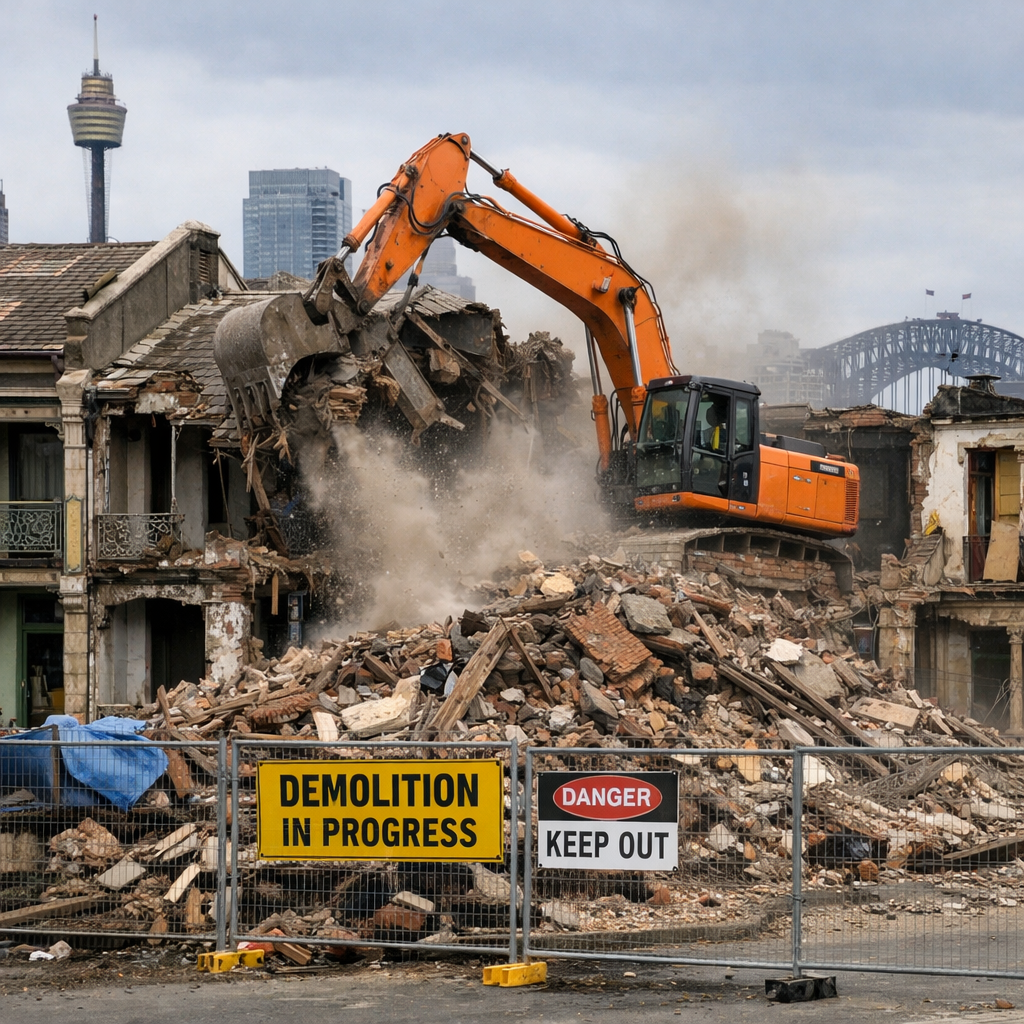
Sydney Terrace Houses Demolition-1
Working With Others Across NSW

SOS Waverley is a member of Doing Density Better, the peak organisation representing community groups across the state who are facing similar concerns about overdevelopment and weakened planning controls.

Eastern Suburbs Community Standing Up for Rights-1

How You Can Help

Attend our community meeting

Join our mailing list

Volunteer your time

Share information with neighbours

Support our advocacy efforts

Contact us at soswaverley@gmail.com